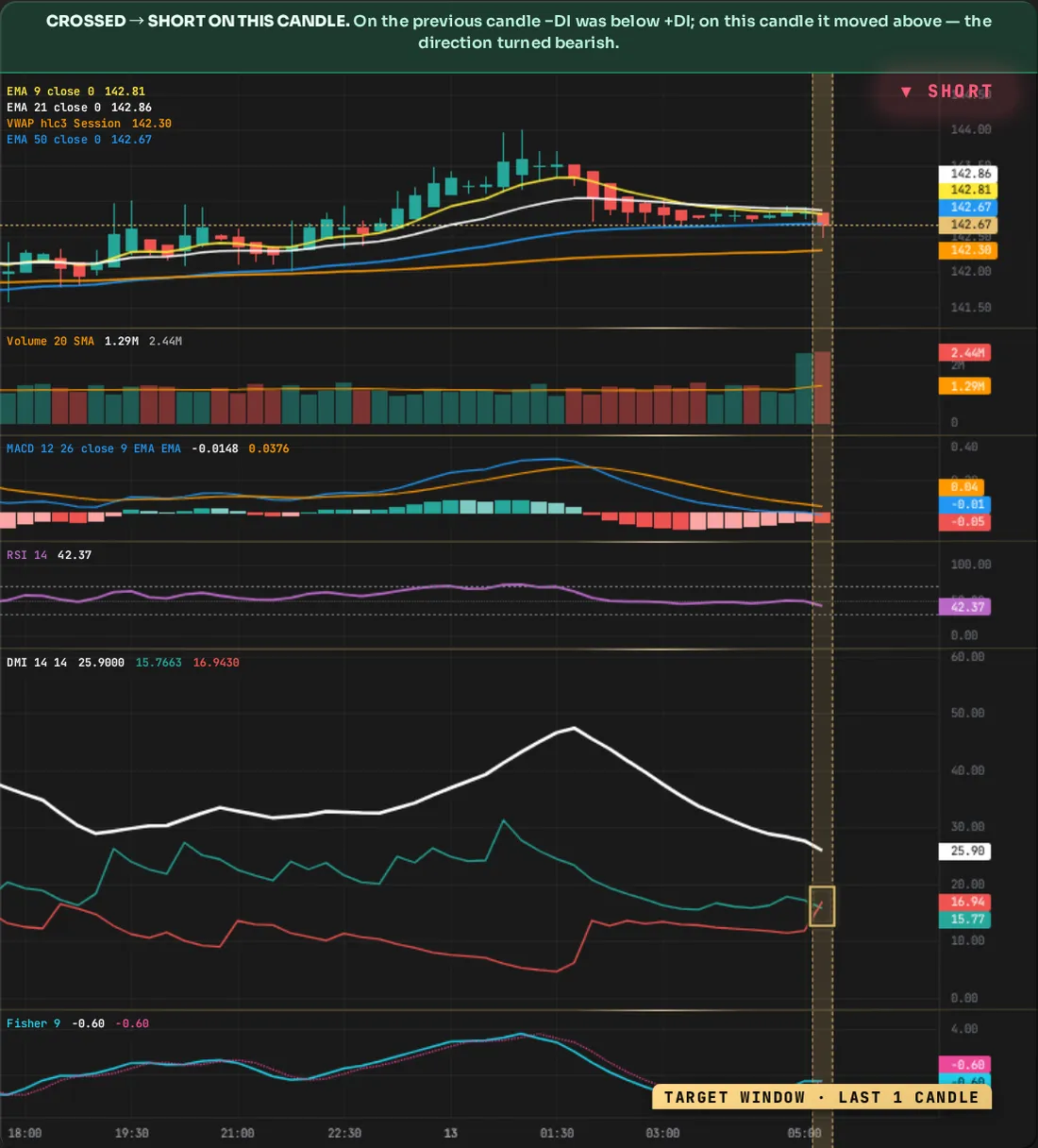
Downward Crossover · −DI Crossed +DI
Main criterionSHORT
The panel has two colored lines: +DI (green) measures buyer pressure, −DI (red) measures seller pressure. Whichever is on top is the currently dominant side. This condition only reads these two lines.
What are DI+ and DI−?
The panel has two colored lines: +DI (green) measures buyer pressure, −DI (red) measures seller pressure. Whichever is on top is the currently dominant side. This condition only reads these two lines.
What does this condition say?
Was −DI below +DI on the previous candle (or exactly at it), and did it move above it on this candle? If so, the seller side has taken the lead and the condition opens SHORT. The crossover is a single-candle event; it's looked back as far as the Crossover Window (default 1 = only the last candle).
How do you use it?
This is a main criterion — it can open an entry on its own. Left as is, it takes every crossover. To narrow it, enter an ADX Level in the panel: crossovers in weak trends get filtered out. Min DI Difference filters out indecisive crossovers when the two lines are stuck together.
Does this condition close the position?
It only approves the entry; even if the lines cross again afterward, it doesn't close the position. What closes it is your choice: if Profit Lock is on, PNL tracking takes over (while it's on, the Trailing Stop, Take Profit Net, Limit Take Profit Net boxes are locked); if it's off, the numbers you entered in these three are placed as orders on Binance and the position closes from there. DCA Rescuer and Liquidation Shield kick in under their own conditions; and you can always close from the panel with CLOSE or manually from Binance.
What is ADX for?
The white line ADX doesn't say direction, it says the strength of the move. Roughly: below 20 the market is sideways — trading is reluctant, crossovers come often and most fizzle out. Above 25 is usually counted as a real move. So if you enter a number in the ADX Level box in the panel, the bot only takes crossovers above that strength; DI+ / DI− Level and Min DI Difference do the same job on the line level.