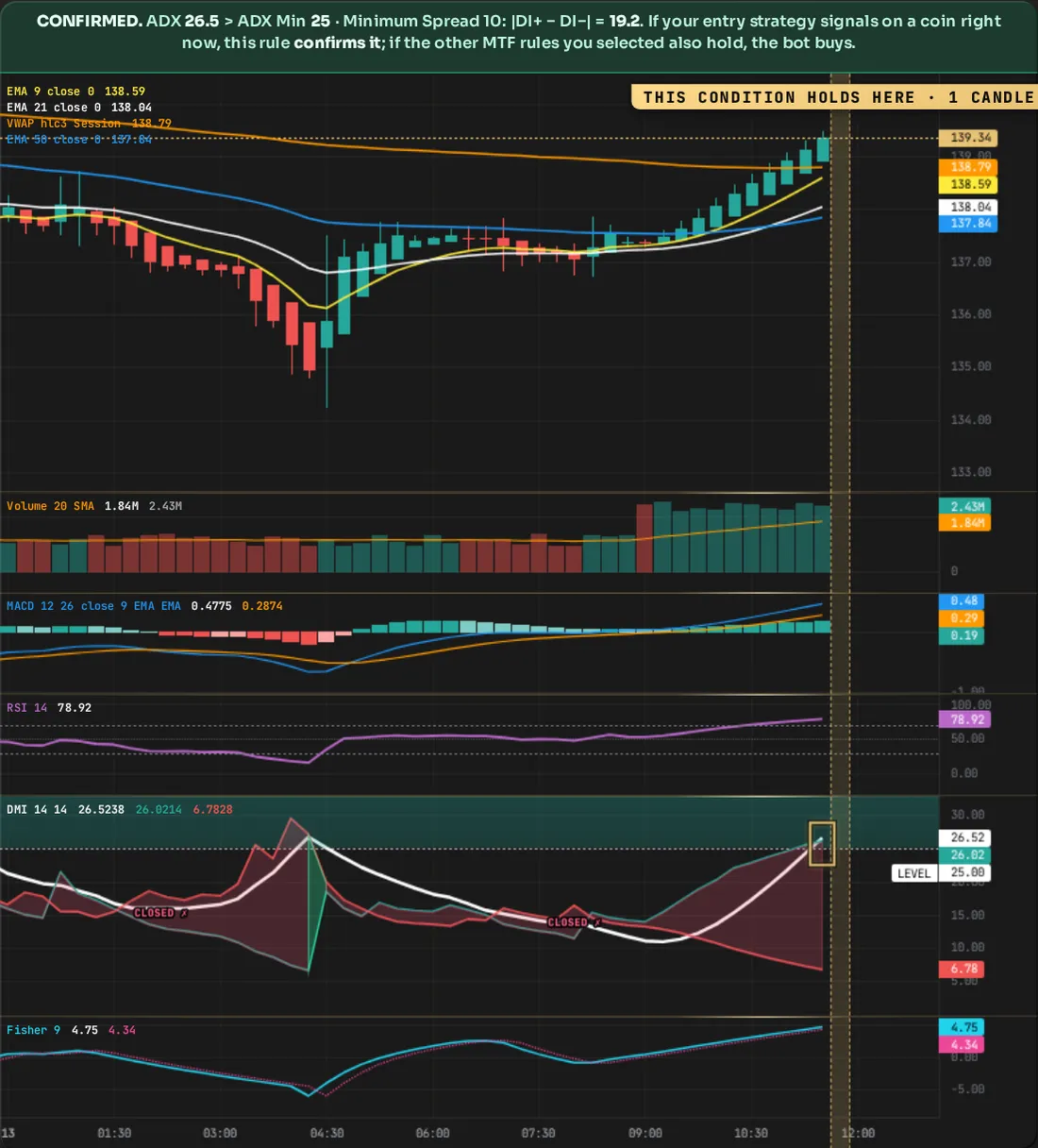
MTF confirmation · ADX / DMI
Higher-timeframe confirmation conditions for ADX / DMI: when your entry strategy gives a signal, the bot checks that this condition also holds on the higher timeframe you chose.
Conditions
MTF · ADX Above Level
What exactly does this condition ask?
On the last candle of your chosen timeframe, the white ADX line must be above the ADX Min (25) value you entered for that timeframe — trend strong. It doesn't ask direction; the same level applies both ways.
Which settings does it read?
When selected, the ADX Min cell opens in the table (25 in the panel); it's independent from the ADX Level in the entry strategy. Raising it opens the gate less often. Also, a Minimum Spread cell opens on every DMI row (default 10): if the gap between the two DI lines is less than this many points, the rule doesn't hold; enter 0 to remove this filter.
How do you use it?
At entry you picked DI+ crossed 50 upward · RSI above 60 · MACD above zero on 5m; on MTF you picked ADX Above Level — 4h · EMA trend up (2h) · Price above VWAP (12h). 10 coins passed the entry on 5m; 4 were filtered out on 2h, 5 were filtered out on this rule on 4h, and 1 coin passed all of them — the bot sent a buy order only for that one. There's no limit, you build the combination: more selections give a rare but consistent alert, fewer selections give a frequent but low-accuracy one — a coin rising on 5m but falling on 4h usually has a small and temporary rise.
What is MTF confirmation?
When your entry strategy gives a signal on a coin, the bot doesn't buy right away; it first checks the rules you selected here. It checks each rule on its own timeframe: you can select multiple timeframes and multiple indicators, and all of them must hold at the same time. If only 2 of the 10 coins that passed the entry strategy also pass all the MTF rules, the bot only buys those 2 coins. MTF never opens a trade on its own; it only filters.
Does this condition close the position?
It only has a say at entry; even if the higher timeframe reverses after the position opens, it doesn't close it. What closes it is your choice: if Profit Lock is on, PNL tracking takes over (while it's on, the Trailing Stop, Take Profit Net, Limit Take Profit Net boxes are locked); if it's off, the numbers you entered in these three are placed as orders on Binance and the position closes from there. DCA Rescuer and Liquidation Shield kick in under their own conditions; and you can always close from the panel with CLOSE or manually from Binance.
MTF · ADX Rising
What exactly does this condition ask?
On your chosen timeframe, the white ADX line must be higher than the previous candle on every one of the last 2 candles (you decide) — trend strengthening. Level isn't checked; only direction. You set this window (candle count) yourself.
Which settings does it read?
When selected, the ADX Rise Candle cell opens in the table (2 in the panel): how many candles it must rise without interruption for; if you enter 0, the engine counts it as 2. Also, a Minimum Spread cell opens on every DMI row (default 10): if the gap between the two DI lines is less than this many points, the rule doesn't hold; enter 0 to remove this filter.
How do you use it?
At entry you picked DI+ crossed 50 upward · RSI above 60 · MACD above zero on 5m; on MTF you picked ADX Rising — 4h · EMA trend up (2h) · Price above VWAP (12h). 10 coins passed the entry on 5m; 4 were filtered out on 2h, 5 were filtered out on this rule on 4h, and 1 coin passed all of them — the bot sent a buy order only for that one. There's no limit, you build the combination: more selections give a rare but consistent alert, fewer selections give a frequent but low-accuracy one — a coin rising on 5m but falling on 4h usually has a small and temporary rise.
What is MTF confirmation?
When your entry strategy gives a signal on a coin, the bot doesn't buy right away; it first checks the rules you selected here. It checks each rule on its own timeframe: you can select multiple timeframes and multiple indicators, and all of them must hold at the same time. If only 2 of the 10 coins that passed the entry strategy also pass all the MTF rules, the bot only buys those 2 coins. MTF never opens a trade on its own; it only filters.
Does this condition close the position?
It only has a say at entry; even if the higher timeframe reverses after the position opens, it doesn't close it. What closes it is your choice: if Profit Lock is on, PNL tracking takes over (while it's on, the Trailing Stop, Take Profit Net, Limit Take Profit Net boxes are locked); if it's off, the numbers you entered in these three are placed as orders on Binance and the position closes from there. DCA Rescuer and Liquidation Shield kick in under their own conditions; and you can always close from the panel with CLOSE or manually from Binance.
MTF · DI− On Top
What exactly does this condition ask?
On the last candle of your chosen timeframe, the red DI− must be above the green DI+ — direction down. A crossover isn't required; being above at that moment is enough.
Which settings does it read?
No separate cell opens for this row. Also, a Minimum Spread cell opens on every DMI row (default 10): if the gap between the two DI lines is less than this many points, the rule doesn't hold; enter 0 to remove this filter.
How do you use it?
At entry you picked DI− crossed 50 upward · RSI below 40 · MACD below zero on 5m; on MTF you picked DI− On Top — 4h · EMA trend down (2h) · Price below VWAP (12h). 10 coins passed the entry on 5m; 4 were filtered out on 2h, 5 were filtered out on this rule on 4h, and 1 coin passed all of them — the bot sent a sell (SHORT) order only for that one. There's no limit, you build the combination: more selections give a rare but consistent alert, fewer selections give a frequent but low-accuracy one — a coin falling on 5m but rising on 4h usually has a small and temporary fall.
What is MTF confirmation?
When your entry strategy gives a signal on a coin, the bot doesn't buy right away; it first checks the rules you selected here. It checks each rule on its own timeframe: you can select multiple timeframes and multiple indicators, and all of them must hold at the same time. If only 2 of the 10 coins that passed the entry strategy also pass all the MTF rules, the bot only buys those 2 coins. MTF never opens a trade on its own; it only filters.
Does this condition close the position?
It only has a say at entry; even if the higher timeframe reverses after the position opens, it doesn't close it. What closes it is your choice: if Profit Lock is on, PNL tracking takes over (while it's on, the Trailing Stop, Take Profit Net, Limit Take Profit Net boxes are locked); if it's off, the numbers you entered in these three are placed as orders on Binance and the position closes from there. DCA Rescuer and Liquidation Shield kick in under their own conditions; and you can always close from the panel with CLOSE or manually from Binance.
MTF · DI− Falling
What exactly does this condition ask?
On your chosen timeframe, the red DI− must be lower than the previous candle on every one of the last 2 candles (you decide) — seller pressure decreasing; an extra confirmation for LONG. You set this window (candle count) yourself.
Which settings does it read?
When selected, the DI Counter cell opens in the table (2 in the panel): how many candles it must fall without interruption for. If you enter 0, this row passes without being checked. Also, a Minimum Spread cell opens on every DMI row (default 10): if the gap between the two DI lines is less than this many points, the rule doesn't hold; enter 0 to remove this filter.
How do you use it?
At entry you picked DI− crossed 50 upward · RSI below 40 · MACD below zero on 5m; on MTF you picked DI− Falling — 4h · EMA trend down (2h) · Price below VWAP (12h). 10 coins passed the entry on 5m; 4 were filtered out on 2h, 5 were filtered out on this rule on 4h, and 1 coin passed all of them — the bot sent a sell (SHORT) order only for that one. There's no limit, you build the combination: more selections give a rare but consistent alert, fewer selections give a frequent but low-accuracy one — a coin falling on 5m but rising on 4h usually has a small and temporary fall.
What is MTF confirmation?
When your entry strategy gives a signal on a coin, the bot doesn't buy right away; it first checks the rules you selected here. It checks each rule on its own timeframe: you can select multiple timeframes and multiple indicators, and all of them must hold at the same time. If only 2 of the 10 coins that passed the entry strategy also pass all the MTF rules, the bot only buys those 2 coins. MTF never opens a trade on its own; it only filters.
Does this condition close the position?
It only has a say at entry; even if the higher timeframe reverses after the position opens, it doesn't close it. What closes it is your choice: if Profit Lock is on, PNL tracking takes over (while it's on, the Trailing Stop, Take Profit Net, Limit Take Profit Net boxes are locked); if it's off, the numbers you entered in these three are placed as orders on Binance and the position closes from there. DCA Rescuer and Liquidation Shield kick in under their own conditions; and you can always close from the panel with CLOSE or manually from Binance.
MTF · DI− Rising (SHORT)
What exactly does this condition ask?
On your chosen timeframe, the red DI− must be higher than the previous candle on every one of the last 2 candles (you decide) — seller pressure increasing; a confirmation for SHORT. You set this window (candle count) yourself.
Which settings does it read?
When selected, the DI Counter cell opens in the table (2 in the panel): how many candles it must rise without interruption for. If you enter 0, this row passes without being checked. Also, a Minimum Spread cell opens on every DMI row (default 10): if the gap between the two DI lines is less than this many points, the rule doesn't hold; enter 0 to remove this filter.
How do you use it?
At entry you picked DI− crossed 50 upward · RSI below 40 · MACD below zero on 5m; on MTF you picked DI− Rising — 4h · EMA trend down (2h) · Price below VWAP (12h). 10 coins passed the entry on 5m; 4 were filtered out on 2h, 5 were filtered out on this rule on 4h, and 1 coin passed all of them — the bot sent a sell (SHORT) order only for that one. There's no limit, you build the combination: more selections give a rare but consistent alert, fewer selections give a frequent but low-accuracy one — a coin falling on 5m but rising on 4h usually has a small and temporary fall.
What is MTF confirmation?
When your entry strategy gives a signal on a coin, the bot doesn't buy right away; it first checks the rules you selected here. It checks each rule on its own timeframe: you can select multiple timeframes and multiple indicators, and all of them must hold at the same time. If only 2 of the 10 coins that passed the entry strategy also pass all the MTF rules, the bot only buys those 2 coins. MTF never opens a trade on its own; it only filters.
Does this condition close the position?
It only has a say at entry; even if the higher timeframe reverses after the position opens, it doesn't close it. What closes it is your choice: if Profit Lock is on, PNL tracking takes over (while it's on, the Trailing Stop, Take Profit Net, Limit Take Profit Net boxes are locked); if it's off, the numbers you entered in these three are placed as orders on Binance and the position closes from there. DCA Rescuer and Liquidation Shield kick in under their own conditions; and you can always close from the panel with CLOSE or manually from Binance.
MTF · DI+ On Top
What exactly does this condition ask?
On the last candle of your chosen timeframe, the green DI+ must be above the red DI− — direction up. A crossover isn't required; being above at that moment is enough.
Which settings does it read?
No separate cell opens for this row. Also, a Minimum Spread cell opens on every DMI row (default 10): if the gap between the two DI lines is less than this many points, the rule doesn't hold; enter 0 to remove this filter.
How do you use it?
At entry you picked DI+ crossed 50 upward · RSI above 60 · MACD above zero on 5m; on MTF you picked DI+ On Top — 4h · EMA trend up (2h) · Price above VWAP (12h). 10 coins passed the entry on 5m; 4 were filtered out on 2h, 5 were filtered out on this rule on 4h, and 1 coin passed all of them — the bot sent a buy order only for that one. There's no limit, you build the combination: more selections give a rare but consistent alert, fewer selections give a frequent but low-accuracy one — a coin rising on 5m but falling on 4h usually has a small and temporary rise.
What is MTF confirmation?
When your entry strategy gives a signal on a coin, the bot doesn't buy right away; it first checks the rules you selected here. It checks each rule on its own timeframe: you can select multiple timeframes and multiple indicators, and all of them must hold at the same time. If only 2 of the 10 coins that passed the entry strategy also pass all the MTF rules, the bot only buys those 2 coins. MTF never opens a trade on its own; it only filters.
Does this condition close the position?
It only has a say at entry; even if the higher timeframe reverses after the position opens, it doesn't close it. What closes it is your choice: if Profit Lock is on, PNL tracking takes over (while it's on, the Trailing Stop, Take Profit Net, Limit Take Profit Net boxes are locked); if it's off, the numbers you entered in these three are placed as orders on Binance and the position closes from there. DCA Rescuer and Liquidation Shield kick in under their own conditions; and you can always close from the panel with CLOSE or manually from Binance.
MTF · DI+ Falling (SHORT)
What exactly does this condition ask?
On your chosen timeframe, the green DI+ must be lower than the previous candle on every one of the last 2 candles (you decide) — buyer pressure decreasing; a confirmation for SHORT. You set this window (candle count) yourself.
Which settings does it read?
When selected, the DI Counter cell opens in the table (2 in the panel): how many candles it must fall without interruption for. If you enter 0, this row passes without being checked. Also, a Minimum Spread cell opens on every DMI row (default 10): if the gap between the two DI lines is less than this many points, the rule doesn't hold; enter 0 to remove this filter.
How do you use it?
At entry you picked DI− crossed 50 upward · RSI below 40 · MACD below zero on 5m; on MTF you picked DI+ Falling — 4h · EMA trend down (2h) · Price below VWAP (12h). 10 coins passed the entry on 5m; 4 were filtered out on 2h, 5 were filtered out on this rule on 4h, and 1 coin passed all of them — the bot sent a sell (SHORT) order only for that one. There's no limit, you build the combination: more selections give a rare but consistent alert, fewer selections give a frequent but low-accuracy one — a coin falling on 5m but rising on 4h usually has a small and temporary fall.
What is MTF confirmation?
When your entry strategy gives a signal on a coin, the bot doesn't buy right away; it first checks the rules you selected here. It checks each rule on its own timeframe: you can select multiple timeframes and multiple indicators, and all of them must hold at the same time. If only 2 of the 10 coins that passed the entry strategy also pass all the MTF rules, the bot only buys those 2 coins. MTF never opens a trade on its own; it only filters.
Does this condition close the position?
It only has a say at entry; even if the higher timeframe reverses after the position opens, it doesn't close it. What closes it is your choice: if Profit Lock is on, PNL tracking takes over (while it's on, the Trailing Stop, Take Profit Net, Limit Take Profit Net boxes are locked); if it's off, the numbers you entered in these three are placed as orders on Binance and the position closes from there. DCA Rescuer and Liquidation Shield kick in under their own conditions; and you can always close from the panel with CLOSE or manually from Binance.
MTF · DI+ Rising
What exactly does this condition ask?
On your chosen timeframe, the green DI+ must be higher than the previous candle on every one of the last 2 candles (you decide) — buyer pressure increasing. You set this window (candle count) yourself.
Which settings does it read?
When selected, the DI Counter cell opens in the table (2 in the panel): how many candles it must rise without interruption for. If you enter 0, this row passes without being checked. Also, a Minimum Spread cell opens on every DMI row (default 10): if the gap between the two DI lines is less than this many points, the rule doesn't hold; enter 0 to remove this filter.
How do you use it?
At entry you picked DI+ crossed 50 upward · RSI above 60 · MACD above zero on 5m; on MTF you picked DI+ Rising — 4h · EMA trend up (2h) · Price above VWAP (12h). 10 coins passed the entry on 5m; 4 were filtered out on 2h, 5 were filtered out on this rule on 4h, and 1 coin passed all of them — the bot sent a buy order only for that one. There's no limit, you build the combination: more selections give a rare but consistent alert, fewer selections give a frequent but low-accuracy one — a coin rising on 5m but falling on 4h usually has a small and temporary rise.
What is MTF confirmation?
When your entry strategy gives a signal on a coin, the bot doesn't buy right away; it first checks the rules you selected here. It checks each rule on its own timeframe: you can select multiple timeframes and multiple indicators, and all of them must hold at the same time. If only 2 of the 10 coins that passed the entry strategy also pass all the MTF rules, the bot only buys those 2 coins. MTF never opens a trade on its own; it only filters.
Does this condition close the position?
It only has a say at entry; even if the higher timeframe reverses after the position opens, it doesn't close it. What closes it is your choice: if Profit Lock is on, PNL tracking takes over (while it's on, the Trailing Stop, Take Profit Net, Limit Take Profit Net boxes are locked); if it's off, the numbers you entered in these three are placed as orders on Binance and the position closes from there. DCA Rescuer and Liquidation Shield kick in under their own conditions; and you can always close from the panel with CLOSE or manually from Binance.
MTF · Stability
What exactly does this condition ask?
On your chosen timeframe, on every one of the last 3 candles (you decide), the DI line matching the strategy's direction must be above the other: DI+ > DI− in LONG, DI− > DI+ in SHORT. If it breaks on even one candle, the gate closes — a majority isn't enough, all must hold. You set this window (candle count) yourself.
Which settings does it read?
When selected, the Stability cell opens in the table (3 in the panel): how many candles it must sustain without interruption. If you enter 0, this row passes without being checked. It takes its direction from the panel's LONG/SHORT selection. Also, a Minimum Spread cell opens on every DMI row (default 10): if the gap between the two DI lines is less than this many points, the rule doesn't hold; enter 0 to remove this filter.
How do you use it?
At entry you picked DI+ crossed 50 upward · RSI above 60 · MACD above zero on 5m; on MTF you picked Stability — 4h · EMA trend up (2h) · Price above VWAP (12h). 10 coins passed the entry on 5m; 4 were filtered out on 2h, 5 were filtered out on this rule on 4h, and 1 coin passed all of them — the bot sent a buy order only for that one. There's no limit, you build the combination: more selections give a rare but consistent alert, fewer selections give a frequent but low-accuracy one — a coin rising on 5m but falling on 4h usually has a small and temporary rise.
What is MTF confirmation?
When your entry strategy gives a signal on a coin, the bot doesn't buy right away; it first checks the rules you selected here. It checks each rule on its own timeframe: you can select multiple timeframes and multiple indicators, and all of them must hold at the same time. If only 2 of the 10 coins that passed the entry strategy also pass all the MTF rules, the bot only buys those 2 coins. MTF never opens a trade on its own; it only filters.
Does this condition close the position?
It only has a say at entry; even if the higher timeframe reverses after the position opens, it doesn't close it. What closes it is your choice: if Profit Lock is on, PNL tracking takes over (while it's on, the Trailing Stop, Take Profit Net, Limit Take Profit Net boxes are locked); if it's off, the numbers you entered in these three are placed as orders on Binance and the position closes from there. DCA Rescuer and Liquidation Shield kick in under their own conditions; and you can always close from the panel with CLOSE or manually from Binance.